Posts Tagged ‘Fireshield’

Protección contra incendios en cubiertas de junco africano: cómo funciona Cape Reed Fireshield

De todas las preguntas que recibimos de arquitectos, promotores inmobiliarios y propietarios que están considerando instalar cubiertas de junco en España, hay una que surge con más frecuencia que cualquier otra: ¿qué ocurre con el riesgo de incendio?

Es una preocupación totalmente comprensible. Los veranos secos de España, los vientos cálidos y unas normativas de construcción cada vez más exigentes hacen que la seguridad contra incendios sea un aspecto fundamental en cualquier estructura exterior. Además, los materiales naturales como el junco africano han tenido históricamente fama de ser combustibles.

En algunos casos, esta percepción ha llevado a algunos propietarios a descartar por completo las cubiertas de junco africano, incluso cuando valoran su estética y conocen sus otras ventajas.

En Cape Reed International llevamos años desarrollando una respuesta integral a esta cuestión. Esa respuesta es Fireshield, nuestro sistema propio de protección retardante del fuego diseñado específicamente para cubiertas de junco.

Fireshield no elimina por completo el riesgo de incendio —ningún sistema de cubierta puede garantizarlo—, pero modifica de forma significativa el comportamiento del junco frente al fuego mediante soluciones medibles y adaptadas a los estándares modernos.

A continuación explicamos cómo funciona y por qué es importante.

La realidad del junco y el fuego

Para entender Fireshield, primero conviene comprender cómo se comportan frente al fuego los materiales naturales utilizados en cubiertas.

La vegetación seca sin tratar, ya sea brezo, paja o junco africano, puede prender y propagar las llamas con relativa rapidez en determinadas condiciones. Este es el origen de muchas de las preocupaciones relacionadas con las cubiertas vegetales, y no carecen de fundamento.

Las cubiertas naturales tradicionales que no incorporan ningún tipo de protección contra incendios pueden presentar un riesgo mayor que las cubiertas de teja de hormigón o metálicas.

Sin embargo, hay dos aspectos importantes que a menudo se pasan por alto.

El primero es que Thamnochortus insignis, el junco africano que utilizamos, presenta una mayor resistencia natural al fuego que muchos otros materiales empleados en cubiertas vegetales, incluido el brezo.

La estructura densa de sus tallos, recubiertos naturalmente de sílice, hace que no prenda con tanta facilidad como el brezo seco o la paja. En su estado natural no es ignífugo, pero tampoco es tan vulnerable como a menudo se presupone.

El segundo aspecto es que un tratamiento retardante del fuego adecuado modifica significativamente el comportamiento de la cubierta.

Cuando se aplica correctamente, un sistema retardante del fuego de calidad reduce considerablemente la facilidad con la que una cubierta de junco africano puede prender y ralentiza la propagación de las llamas, hasta el punto de que, en determinadas evaluaciones, su comportamiento puede compararse con el de materiales de cubierta convencionales.

Fireshield es ese sistema.

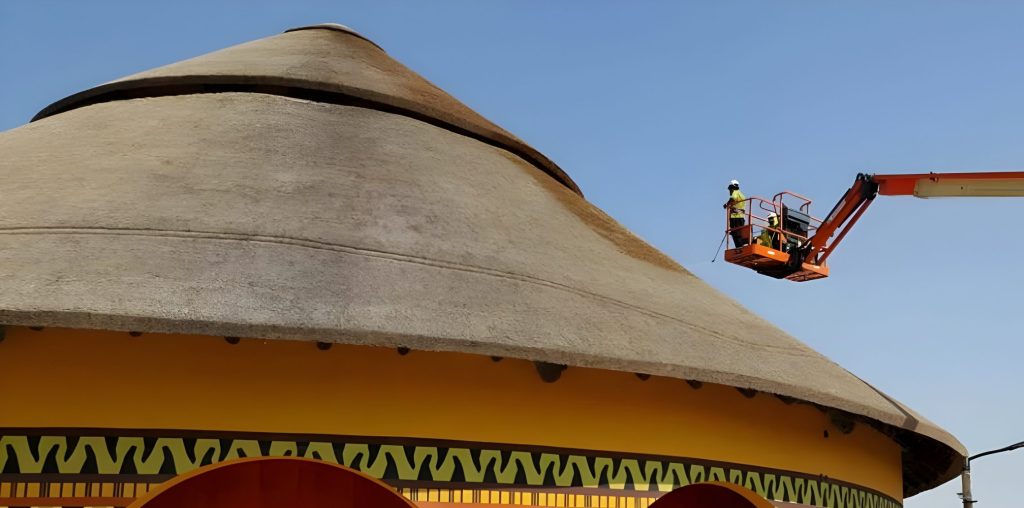
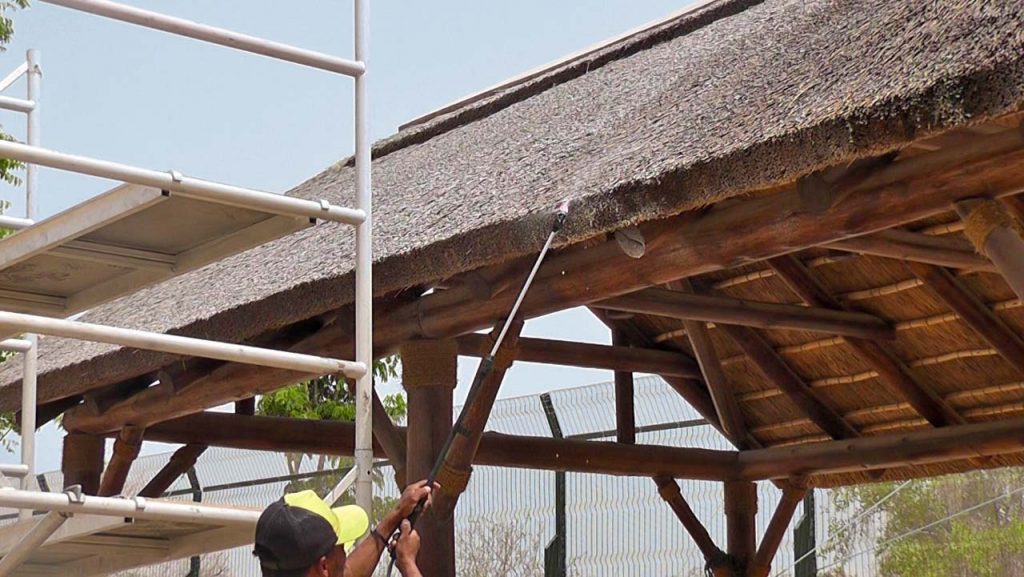
Cape Reed Fireshield Application
Aplicación del revestimiento Fireshield en cubierta de junco africano

Fireshield es ese sistema.

Fireshield es un sistema de protección retardante del fuego compuesto por varias capas e integrado en las instalaciones de cubiertas Cape Reed.

Consta de dos componentes principales que funcionan conjuntamente.

FireBloc es un tejido retardante del fuego que se instala durante la construcción, debajo de la superficie terminada de junco.

Actúa como una barrera física entre posibles fuentes de ignición procedentes de la parte inferior, por ejemplo, una brasa de un fuego cercano o el calor generado por instalaciones eléctricas y el propio junco.

FireBloc se integra en la estructura de la cubierta como parte del sistema de instalación de Cape Reed. No se trata simplemente de un tratamiento aplicado posteriormente sobre la superficie.

Al instalarse durante la construcción, proporciona una capa de protección integrada que permanece en la estructura y no requiere reaplicaciones periódicas.

Revestimiento Fireshield: tratamiento de la superficie

Fireshield es un revestimiento retardante del fuego aplicado profesionalmente mediante pulverización sobre la superficie exterior terminada del junco.

El producto penetra en la estructura formada por los haces de junco africano y aumenta significativamente la resistencia del material frente a la ignición y la propagación de las llamas.

A diferencia de algunos tratamientos ignífugos que pueden modificar visiblemente el aspecto de la superficie, Fireshield está formulado para tener un impacto mínimo sobre la estética natural del junco africano.

La cubierta terminada conserva su característico tono dorado similar a la miel y su textura natural, sin dejar una película visible, alterar significativamente el color ni generar residuos perceptibles.

El revestimiento Fireshield sí requiere una reaplicación periódica dentro del mantenimiento habitual de la cubierta, normalmente cada cinco a siete años, dependiendo del nivel de exposición a las condiciones meteorológicas y a la radiación UV.

Se trata de un procedimiento relativamente sencillo que nuestro equipo puede llevar a cabo durante una visita de mantenimiento.
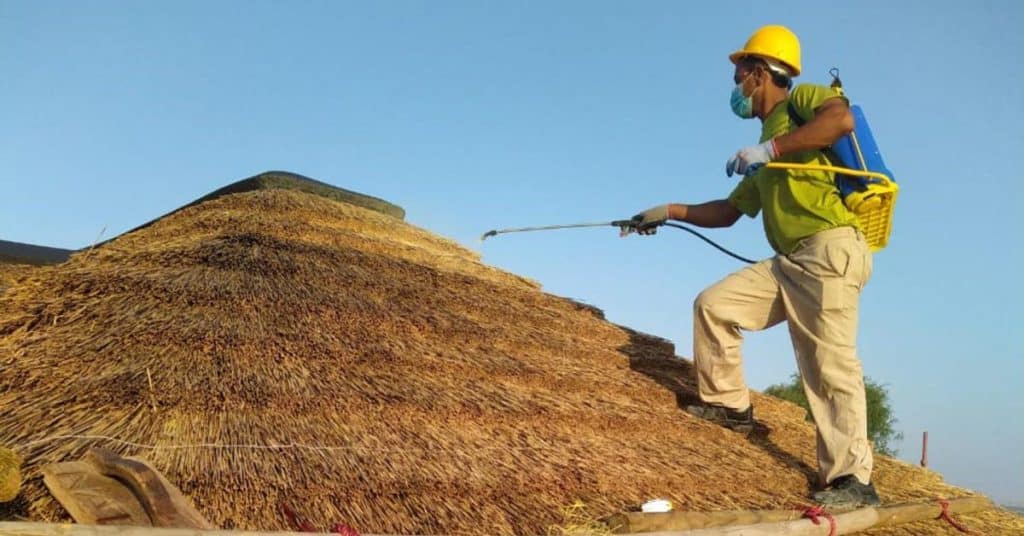
Cape Reed Fireshield Application
Cubierta de junco tratada con solución retardante de incendios para protección en verano

Normativa española de seguridad contra incendios para estructuras exteriores

El marco normativo español en materia de seguridad contra incendios en edificios se rige principalmente por el Código Técnico de la Edificación (CTE) y, en concreto, por el Documento Básico SI – Seguridad en caso de Incendio, según se indica en el documento original.

En estructuras destinadas a usos hoteleros, comerciales o residenciales colectivos, el cumplimiento de los requisitos aplicables en materia de seguridad contra incendios puede formar parte del proceso de aprobación e inspección del proyecto.

En el caso de materiales naturales utilizados en cubiertas exteriores, el documento identifica dos parámetros principales:

  • La reacción al fuego, es decir, la facilidad con la que un material puede prender y contribuir a la propagación del fuego.
  • La propagación exterior del fuego, que analiza cómo se comporta una cubierta cuando queda expuesta a una fuente externa de incendio, como una estructura cercana o una brasa transportada por el viento.

El texto fuente indica que los materiales utilizados en cubiertas se evalúan mediante las normas europeas EN 13501-5, relativa al comportamiento frente al fuego exterior, y EN 13501-1, relativa a la reacción al fuego.

Según el documento, el sistema Cape Reed tratado con Fireshield alcanza niveles de clasificación adecuados para los requisitos aplicables a determinadas estructuras exteriores de hostelería, pérgolas, gazebos y construcciones auxiliares residenciales en España.

Cape Reed International puede proporcionar documentación técnica sobre los ensayos realizados y la clasificación de sus materiales para aquellos proyectos que requieran demostrar formalmente su cumplimiento, ya sea para trámites administrativos, aseguradoras o procesos de control de obra.

Por qué es importante para su proyecto

Para establecimientos de hostelería y proyectos comerciales

Beach clubs, zonas de piscina de hoteles, restaurantes al aire libre y estructuras situadas en resorts pueden estar sujetos a requisitos especialmente exigentes en materia de seguridad contra incendios.

Las comunidades de propietarios, operadores hoteleros y titulares de licencias comerciales tienen la responsabilidad de garantizar que sus instalaciones cumplan la normativa aplicable.

Los materiales naturales para cubiertas que no cuentan con tratamientos adecuados reciben cada vez mayor atención tanto por parte de los inspectores como de las aseguradoras.

Con Fireshield, Cape Reed puede proporcionar a sus clientes del sector de la hostelería documentación que les permita respaldar el cumplimiento de los requisitos aplicables y ofrecer a las aseguradoras mayor información sobre las características del sistema instalado.

Para viviendas situadas en zonas con riesgo de incendio

El sur de España ha experimentado temporadas de incendios forestales cada vez más severas.

Las propiedades situadas en zonas clasificadas como de alto riesgo de incendio, incluidas distintas áreas del interior de la Costa del Sol, Sierra Bermeja y determinadas zonas costeras con pinares, pueden estar sometidas a un mayor control por parte de las autoridades locales y las compañías aseguradoras.

Para los propietarios de viviendas situadas en estas zonas, disponer de un gazebo, una pérgola u otra estructura exterior de junco tratada con Fireshield puede reducir tanto el riesgo práctico como determinadas preocupaciones relacionadas con los seguros asociadas a los materiales naturales de cubierta.

Para arquitectos y profesionales responsables de la especificación

Para los arquitectos que incorporan estructuras exteriores en proyectos residenciales de lujo o proyectos comerciales, poder utilizar junco natural y, al mismo tiempo, cumplir los requisitos aplicables de seguridad contra incendios amplía considerablemente las posibilidades de diseño.

Fireshield permite combinar la libertad estética que ofrecen los materiales naturales con una solución desarrollada para responder a las exigencias técnicas de este tipo de proyectos.

Cape Reed International cuenta con experiencia trabajando junto a equipos de arquitectura durante las fases de especificación y aprobación, y puede proporcionar fichas técnicas de producto, informes de ensayos y asistencia técnica durante las distintas etapas del proyecto.

Cape Reed Fireshield es un producto químico especialmente formulado que se puede aplicar tanto al junco como a la madera

Mantenimiento y cumplimiento a largo plazo

La seguridad contra incendios no debe considerarse únicamente en el momento de la instalación. También requiere un mantenimiento continuado.

En las cubiertas de Cape Reed, esto incluye:

  • Reaplicar periódicamente el revestimiento Fireshield, normalmente cada cinco a siete años.
  • Realizar una inspección visual de la superficie de junco y de la estructura situada debajo al menos cada dos años.
  • Controlar la vegetación cercana y otros materiales combustibles que podrían actuar como fuentes de ignición durante los periodos secos.
  • Mantener vías de acceso adecuadas para los servicios de emergencia cuando así lo exija la normativa.

Cape Reed International ofrece programas de mantenimiento para las estructuras de madera que instala, que pueden incluir la reaplicación programada de Fireshield, la inspección del junco africano y la evaluación de la estructura.

Conservar un registro de estas visitas de mantenimiento también puede resultar útil a efectos del seguro, ya que permite demostrar que la estructura ha recibido un mantenimiento activo y periódico.

Ideas equivocadas habituales sobre el junco y el fuego

«Las cubiertas de junco africano son demasiado peligrosas para utilizarse en propiedades comerciales»

Esta afirmación no refleja necesariamente las soluciones actuales disponibles.

Con el sistema Fireshield, las estructuras de madera de Cape Reed se han instalado en distintos proyectos hoteleros y resorts en Europa, los Emiratos Árabes Unidos, Arabia Saudí y España.

El cumplimiento de los requisitos aplicables es posible siempre que se utilicen los materiales adecuados y se adopte un enfoque técnico apropiado.

«Los tratamientos retardantes del fuego estropean el aspecto natural del junco africano»

El revestimiento Fireshield está formulado específicamente para preservar el aspecto de la superficie terminada del junco africano.

El tratamiento está diseñado para no producir cambios visibles significativos en la textura o el color, permitiendo mantener la belleza natural del material.

«Una vez tratado, el junco queda protegido para siempre»

Los revestimientos aplicados sobre la superficie requieren reaplicaciones con el paso del tiempo.

Sin embargo, la capa FireBloc integrada en la estructura permanece instalada durante toda la vida útil de la cubierta.

La reaplicación del revestimiento Fireshield es relativamente sencilla y puede incorporarse a un programa periódico de mantenimiento.

Que hacemos fireshield exterior aplicacion

Conclusión

La seguridad contra incendios es un aspecto que debe tenerse en cuenta en cualquier proyecto serio de cubiertas de junco en España.

Con el sistema Fireshield de Cape Reed, esta cuestión puede abordarse mediante una combinación de soluciones técnicas: la barrera FireBloc integrada en la estructura, el revestimiento superficial Fireshield y la experiencia de Cape Reed en la instalación de estructuras naturales en Europa y Oriente Medio.

El objetivo es que las preocupaciones relacionadas con el fuego no impidan disfrutar de una cubierta natural cuidadosamente diseñada, siempre que el proyecto incorpore las medidas de protección y mantenimiento adecuadas.

Cape Reed International cuenta con más de 20 años de experiencia instalando estructuras de junco africano en Europa y Oriente Medio.

Si está especificando un proyecto o está considerando instalar una cubierta de junco africano y tiene preguntas sobre seguridad contra incendios, documentación técnica o requisitos relacionados con seguros, estaremos encantados de estudiar su caso concreto.

Contacte con nuestro equipo →

La seguridad contra incendios es un aspecto que debe tenerse en cuenta en cualquier proyecto serio de cubiertas de junco en España.

Con el sistema Fireshield de Cape Reed, esta cuestión puede abordarse mediante una combinación de soluciones técnicas: la barrera FireBloc integrada en la estructura, el revestimiento superficial Fireshield y la experiencia de Cape Reed en la instalación de estructuras naturales en Europa y Oriente Medio.

El objetivo es que las preocupaciones relacionadas con el fuego no impidan disfrutar de una cubierta natural cuidadosamente diseñada, siempre que el proyecto incorpore las medidas de protección y mantenimiento adecuadas.

Cape Reed International cuenta con más de 20 años de experiencia instalando estructuras de junco africano en Europa y Oriente Medio.

Si está especificando un proyecto o está considerando instalar una cubierta de junco africano y tiene preguntas sobre seguridad contra incendios, documentación técnica o requisitos relacionados con seguros, estaremos encantados de estudiar su caso concreto.

Preguntas frecuentes

¿Qué clasificación frente al fuego alcanza Cape Reed Fireshield?

Según el documento original, el sistema Cape Reed tratado con Fireshield dispone de clasificaciones de comportamiento frente al fuego evaluadas conforme a EN 13501-1, relativa a la reacción al fuego, y EN 13501-5, relativa al comportamiento frente al fuego exterior.

Cape Reed puede proporcionar documentación técnica completa e informes de ensayos previa solicitud para aquellos proyectos que necesiten acreditar formalmente estos aspectos.

¿Todas las instalaciones Cape Reed incluyen Fireshield?

Sí. Según el documento, el tejido retardante del fuego FireBloc se incorpora de forma estándar en las instalaciones Cape Reed.

El revestimiento superficial Fireshield se aplica sobre el junco una vez terminada la cubierta como parte del proceso habitual.

Ambos componentes están incluidos salvo que el cliente solicite expresamente un enfoque alternativo, algo que, según el texto original, ocurre en muy pocas ocasiones.

Alcazaba Beach, Estepona

Situado en primera línea de playa en Estepona, Alcazaba Beach es uno de los complejos residenciales más prestigiosos de la Costa del Sol. Diseñado por el reconocido arquitecto marbellí Melvin Villaroel, el proyecto destaca por su arquitectura inspirada en la naturaleza, sus exuberantes jardines tropicales y su atemporal carácter mediterráneo.

A lo largo de los años, Alcazaba Beach ha recibido diversos premios de arquitectura por su paisajismo y por su integración armoniosa en el entorno natural. Muchos de sus espacios comunitarios, entre ellos el gimnasio y el bar de la piscina, contaban con cubiertas tradicionales terminadas con brezo español.

Sin embargo, tras décadas de exposición al clima costero, la comunidad decidió que había llegado el momento de renovar y modernizar estas emblemáticas cubiertas sin perder su aspecto natural.

Fue entonces cuando Cape Reed International fue seleccionada para llevar a cabo los trabajos de rehabilitación.

Renovación de cubiertas tradicionales de brezo con junco africano de primera calidad

El objetivo del proyecto era claro desde el principio. Las cubiertas debían conservar su estética cálida y natural, pero ofrecer mejoras significativas en cuanto a durabilidad, impermeabilización, integridad estructural y protección contra incendios.

Cape Reed International llevó a cabo un proceso completo de rehabilitación que incluyó:

  • Desmontaje y retirada de las cubiertas de brezo existentes
  • Reparación y refuerzo de las estructuras de madera
  • Rehabilitación de la subestructura de las cubiertas mediante nuevos listones y correas de madera
  • Reparación de las capas de impermeabilización dañadas
  • Instalación de 300 m² de junco africano de primera calidad (Thamnochortus insignis)
  • Incorporación del tejido ignífugo Cape Reed FireBloc en todo el sistema de cubierta
  • Acabado de las cubiertas con remates de cemento pintado y detalles de acabado
  • Aplicación del revestimiento ignífugo Cape Reed Fireshield para proporcionar una protección adicional

Como resultado, las cubiertas rehabilitadas combinan ahora una auténtica estética natural con estándares actuales de rendimiento y seguridad.

Twin thatched poolside cabanas at Alcazaba Beach Estepona refurbished by Cape Reed International Spain
Cabañas gemelas de junco con vistas a la piscina en Alcazaba Beach — un proyecto de rehabilitación de lujo frente al mar, completado por Cape Reed International en marzo de 2026

Combinación de artesanía tradicional y protección moderna

Uno de los aspectos más destacados de este proyecto fue el equilibrio entre las técnicas tradicionales de construcción de tejados y las tecnologías avanzadas de protección contra incendios.

La instalación de junco africano Cape Reed de primera calidad permitió lograr un acabado visual refinado que complementa los jardines tropicales y la identidad arquitectónica de Alcazaba Beach. Al mismo tiempo, la incorporación de los sistemas Cape Reed FireBloc y Fireshield mejoró considerablemente la protección contra incendios de las estructuras.

Esta combinación permitió a la comunidad preservar la belleza natural del diseño original y, al mismo tiempo, mejorar su durabilidad y su rendimiento a largo plazo.

Gestión de los retos del clima costero durante la construcción

Como sucede en muchos proyectos situados en zonas costeras, esta rehabilitación planteó varios retos técnicos.

Uno de los principales obstáculos fue el invierno excepcionalmente lluvioso que se registró en la Costa del Sol durante los trabajos. Las fuertes precipitaciones afectaron al calendario de instalación y exigieron una cuidadosa coordinación durante todo el proceso de rehabilitación.

El equipo de Cape Reed trabajó estrechamente con el equipo gestor de la urbanización, facilitando actualizaciones periódicas sobre el avance de las obras y minimizando, en la medida de lo posible, las molestias para los residentes.

Además, aunque las estructuras originales de madera se encontraban en gran parte en buenas condiciones, algunas zonas presentaban signos de desgaste por el paso del tiempo. Durante los trabajos se detectaron pequeños puntos de deterioro de la madera y daños provocados por insectos.

Por este motivo, se instalaron soportes de madera adicionales para reforzar las estructuras y garantizar que pudieran soportar de forma segura el nuevo sistema de cubierta de junco africano durante muchos años.

Luxury thatched roof cabanas at Alcazaba Beach Estepona after refurbishment by Cape Reed Spain
Rehabilitación completada de la cubierta de junco en Alcazaba Beach, Estepona — belleza natural restaurada, rendimiento mejorado y protección contra incendios integrada en todo el sistema

Un proyecto comercial de rehabilitación completado con éxito en España

Los trabajos de rehabilitación comenzaron en noviembre de 2025 y finalizaron con éxito en marzo de 2026.

Actualmente, las cubiertas renovadas continúan realzando el ambiente exclusivo y mediterráneo de Alcazaba Beach, al mismo tiempo que ofrecen mayores niveles de seguridad, integridad estructural y protección a largo plazo frente a las condiciones del clima costero.

El proyecto refleja la experiencia de Cape Reed International en la restauración y mejora de sistemas de cubiertas naturales para complejos residenciales y proyectos comerciales de alto nivel en España y Europa.

Por qué el junco Cape Reed es ideal para proyectos residenciales y de hostelería en entornos costeros

El junco Cape Reed ofrece numerosas ventajas para desarrollos costeros de lujo y espacios de hostelería.

Estética mediterránea natural

El junco Cape Reed se integra perfectamente en jardines tropicales, propiedades frente al mar y espacios exteriores destinados al ocio.

Excelentes propiedades de aislamiento

Las cubiertas de junco ayudan a regular la temperatura y permiten crear zonas de sombra más frescas y confortables.

Durabilidad en condiciones costeras

Cuando se instala correctamente y se combina con sistemas de impermeabilización y mantenimiento de calidad, el junco Cape Reed ofrece un excelente rendimiento en entornos costeros.

Mayor protección contra incendios

Los sistemas Cape Reed FireBloc y Fireshield proporcionan una protección ignífuga adicional para las estructuras de cubiertas naturales.

Una solución constructiva sostenible

El junco Cape Reed es un material natural renovable que contribuye a una arquitectura y un diseño más respetuosos con el medio ambiente.

Refurbished thatched roof gazebo at Alcazaba Beach Estepona with Cape Reed thatch and tropical gardens
La estructura renovada del gimnasio en Alcazaba Beach, Estepona — 300 m² de junco africano Cape Reed de primera calidad que se integra a la perfección con los jardines mediterráneos premiados de la urbanización

Especialistas en rehabilitación y cubiertas comerciales en España

Cape Reed International continúa trabajando en proyectos residenciales de lujo, proyectos de hostelería y desarrollos comerciales en España y en toda Europa.

Nuestra experiencia incluye:

  • Cubiertas tradicionales de junco
  • Rehabilitación de cubiertas de junco
  • Construcción en madera
  • Sistemas de cubierta con protección ignífuga
  • Estructuras exteriores para proyectos de hostelería
  • Soluciones de cubiertas naturales
  • Arquitectura exterior adaptada a entornos costeros y a las condiciones climáticas

Descubra más proyectos en Cape Reed Projects.

Preguntas frecuentes

¿Qué trabajos realizó Cape Reed International en Alcazaba Beach?

Cape Reed International llevó a cabo una rehabilitación completa de las cubiertas, sustituyendo las cubiertas existentes de brezo por junco Cape Reed de primera calidad y mejorando al mismo tiempo los soportes estructurales, la impermeabilización y los sistemas de protección contra incendios.

¿Qué tipo de junco se utilizó para la rehabilitación?

En el proyecto se utilizó junco Cape Reed de primera calidad (Thamnochortus insignis), conocido por su durabilidad, su aspecto natural y su idoneidad para espacios exteriores de lujo.

¿Cómo se incorporó la protección contra incendios al sistema de cubierta?

Cape Reed instaló tejido ignífugo FireBloc dentro de la estructura de la cubierta y aplicó el revestimiento ignífugo Cape Reed Fireshield sobre las superficies terminadas.

Por qué la protección contra incendios es esencial en España

Los veranos en España son conocidos por su belleza: días largos y soleados, una animada vida al aire libre y un sector de la hostelería muy activo. Sin embargo, estas condiciones también traen consigo una preocupación cada vez mayor y muy real: el riesgo de incendios.

Con el aumento de las temperaturas, las condiciones secas y el uso intensivo de los espacios exteriores, las propiedades de toda España, especialmente en regiones como la Costa del Sol presentan una mayor vulnerabilidad durante los meses de verano.

Tanto para empresarios como para propietarios, la protección contra incendios ya no es opcional: es esencial.

Comprender el riesgo de incendio en estructuras exteriores

Los espacios exteriores suelen incorporar materiales naturales y elementos construidos en madera, como:

  • Cubiertas de junco africano
  • Pérgolas de madera
  • Terrazas de madera
  • Zonas exteriores de restauración a la sombra

Aunque estos materiales permiten crear espacios atractivos y funcionales, también pueden convertirse en elementos de mayor riesgo si no reciben el tratamiento adecuado.

Sin una protección contra incendios eficaz, una sola chispa puede propagarse rápidamente y poner en riesgo a personas, propiedades y negocios.

Cape Reed Fireshield Application
Aplicación del tratamiento ignífugo Cape Reed Fireshield en cubiertas de madera y junco africano

¿Qué es Cape Reed Fireshield?

Cape Reed Fireshield es un tratamiento retardante del fuego especialmente desarrollado para reducir significativamente el riesgo de ignición y ralentizar la propagación del fuego en estructuras construidas con materiales naturales y madera.

Se utiliza en una amplia variedad de proyectos, entre ellos:

  • Resorts de lujo
  • Beach clubs y restaurantes
  • Proyectos comerciales
  • Villas privadas

Esto lo convierte en una solución eficaz para mejorar la protección contra incendios en espacios exteriores en España.

👉 Descubra más sobre nuestra solución de protección contra incendios:
https://www.capereed.es/es/que-hacemos/proteccion-ignifuga

Por qué Fireshield es esencial durante el verano europeo

1. Reduce el riesgo de incendio

Fireshield ayuda a proteger las estructuras de junco africano y madera, reduciendo significativamente su susceptibilidad a la ignición.

2. Ralentiza la propagación del fuego

En caso de incendio, los materiales tratados presentan una menor probabilidad de favorecer una rápida propagación de las llamas, lo que puede proporcionar un tiempo adicional muy valioso para reaccionar.

3. Ayuda a cumplir los requisitos de seguridad

Las normas y exigencias relacionadas con la seguridad contra incendios están adquiriendo cada vez mayor importancia en España y en toda Europa, especialmente para los establecimientos del sector de la hostelería.

4. Protege su inversión

Las estructuras exteriores pueden representar una inversión considerable, y Fireshield ayuda a protegerlas y prolongar su vida útil.

Cape Reed Fireshield Application
Estructura de cubierta de junco tratada con solución ignífuga para protección contra incendios en verano

Una solución especialmente importante para la Costa del Sol y otras regiones cálidas

Regiones como la Costa del Sol experimentan largos periodos de calor y sequedad, lo que puede aumentar considerablemente el riesgo de incendios.

En restaurantes, hoteles y beach clubs, este riesgo puede verse incrementado por factores como:

  • Una elevada afluencia de clientes
  • El uso de llamas abiertas, como velas, cocinas o calentadores
  • Instalaciones eléctricas en espacios exteriores

Cape Reed Fireshield desempeña un papel importante a la hora de reducir estos riesgos y ayuda a los negocios a operar de forma más segura durante los meses de mayor calor.

Aplicaciones ideales para Cape Reed Fireshield

Fireshield es adecuado para una amplia variedad de estructuras y espacios, entre ellos:

  • Sistemas de cubiertas de junco africano
  • Pérgolas y gazebos
  • Revestimientos y terrazas de madera
  • Zonas exteriores de restauración

Si su proyecto incorpora materiales naturales, aplicar un tratamiento retardante del fuego es una medida responsable que puede mejorar significativamente la seguridad de la estructura.

Que hacemos fireshield exterior interior aplicacion
Gazebo con cubierta de junco protegido con tratamiento ignífugo para una restauración exterior segura

Combinación de Fireshield con tejas de junco africano

En proyectos que utilizan tejas de junco africano, combinarlas con Fireshield permite conseguir un excelente equilibrio entre estética, rendimiento y seguridad.

Esta combinación ofrece:

  • El aspecto atemporal del junco africano natural
  • El rendimiento de materiales fabricados con precisión
  • Una protección adicional gracias al tratamiento retardante del fuego

Esta solución resulta especialmente valiosa en establecimientos de hostelería, donde tanto el diseño como la seguridad desempeñan un papel fundamental.

👉 Descubra nuestras soluciones de tejas de junco africano:
https://www.capereed.es/es/que-hacemos/Tejas-de-Junco-Africano

Compre Cape Reed Fireshield online en Europa

Con la llegada del verano, el mejor momento para actuar es antes de que las temperaturas alcancen sus niveles más altos.

👉 Compre Cape Reed Fireshield aquí:
https://www.capereed.es/es/tienda/fireshield-es

Comprar online facilita la protección de su propiedad de forma rápida y eficiente.

Por qué las empresas están tomando medidas ahora

Cada vez más empresas en España están invirtiendo en medidas de prevención contra incendios porque:

  • Los requisitos de las aseguradoras son cada vez más exigentes
  • La seguridad de los clientes es una prioridad
  • La reputación es fundamental en mercados de hostelería altamente competitivos

Tomar medidas preventivas hoy puede ayudar a evitar consecuencias graves en el futuro.

Conclusión: no espere hasta que sea demasiado tarde

El riesgo de incendio no siempre ofrece señales de advertencia: puede aumentar progresivamente debido al calor, la sequedad y la exposición prolongada a condiciones extremas.

Cape Reed Fireshield permite adoptar medidas preventivas, proteger lo que más importa y disfrutar del verano con mayor tranquilidad.

Proteja sus estructuras. Proteja su negocio. Proteja su tranquilidad.

What Is Cape Reed Thatch — And Why Is It Different From Brezo?

If you have ever visited a beachfront resort, a luxury villa, or a boutique hotel in southern Spain and admired the natural warmth of its rooftops, there is a good chance you were looking at thatched roofing. But not all thatched roofs are equal — and in Spain, the distinction matters.

For generations, Spanish builders and landscapers have used brezo, a locally harvested heather plant, to create rustic thatched roofs and pergola coverings. It is a traditional material with deep roots in Iberian architecture. However, as property owners, architects, and community administrators have discovered, brezo has real limitations — particularly when it comes to longevity, fire safety, and long-term performance in coastal climates.

At Cape Reed International, we work exclusively with Thamnochortus insignis, a premium reed harvested sustainably in South Africa. It is the material behind some of the most celebrated outdoor structures on the Costa del Sol, in Portugal, Belgium, and across the Arabian Gulf — and it performs at a fundamentally different level.

Here is what you need to know.

What Is Brezo?

Brezo is the Spanish term for common heather (Calluna vulgaris or Erica species), a flowering shrub that grows abundantly across the Iberian Peninsula. Traditionally, dried heather bundles were layered onto timber frames to create low-cost, naturalistic roof coverings for gazebos, bar terraces, garden structures, and poolside cabanas.

Its appeal is immediate and obvious. Brezo looks organic and rustic, blends beautifully into Mediterranean garden settings, and is inexpensive to source and install. For many years it was the default choice for outdoor roofing across the Costa del Sol and beyond.

However, brezo has a fundamental problem: it deteriorates quickly. In coastal environments — with salt air, intense UV exposure, and damp winters — brezo roofs typically begin to degrade within three to five years. The heather dries out, becomes brittle, loses its colour, and eventually breaks apart. Waterproofing performance drops sharply. And without specialist fire-retardant treatment, dried brezo presents a significant fire risk.

What Is Cape Reed Thatch?

Cape Reed thatch refers specifically to roofing made from Thamnochortus insignis, a restio reed native to the Western Cape region of South Africa. It is a grass-like plant that grows in the fynbos biome — one of the world’s most biodiverse plant ecosystems — and has been used in Southern African thatching for centuries.

What makes Thamnochortus insignis exceptional as a roofing material is its physical structure. Each reed stem is dense, hollow, and coated with a natural silica layer that gives it outstanding resistance to moisture, UV radiation, and biological decay. Unlike brezo, which is essentially a dried flowering shrub, Cape Reed is a true thatching grass engineered by nature for resilience.

When harvested at the correct maturity and installed by experienced thatchers, a Cape Reed roof will typically last between 15 and 25 years — three to five times longer than brezo under equivalent conditions.

Natural stone mountain lodge with premium Cape Reed thatched roof blending into the rugged Sierra Morena landscape, Almuradiel, Ciudad Real

Five Key Differences Between Cape Reed and Brezo

1. Longevity

This is the most significant practical difference. A professionally installed Cape Reed thatched roof on a coastal property in southern Spain can be expected to perform well for 15 to 25 years before requiring refurbishment. Brezo, in the same environment, commonly needs replacing within 3 to 7 years.

For property owners, resort managers, and community administrators, this difference is transformative. The higher upfront investment in Cape Reed thatch is almost always recovered within the first replacement cycle — and usually well before.

2. Fire Safety

Dried heather is highly combustible. Without active fire-retardant treatment, a brezo roof presents a serious fire risk, particularly in Spain’s hot, dry summer months. Fire codes across Spain are increasingly strict about natural roofing materials on commercial and residential properties, and many insurance providers treat untreated brezo as a liability.

Cape Reed International addresses this through our proprietary Fireshield system — a multi-layer approach to fire protection that includes Cape Reed FireBloc fire-retardant underlay cloth and a topically applied Fireshield fire-retardant coating on the finished thatch surface. Together, these measures significantly reduce ignition risk and bring thatched structures into compliance with modern fire safety standards.

Cape Reed Fireshield Application

3. Waterproofing Performance

A properly laid Cape Reed roof, installed at the correct pitch with appropriate underlay and capping details, is a genuinely weatherproof roofing system. The density and silica coating of the reed stems create a natural layered barrier that sheds water efficiently, even in heavy rainfall.

Brezo, by contrast, is rarely installed to provide true waterproofing. It is more commonly used as a decorative covering over an existing structure rather than as a primary weatherproof membrane. As the material dries and contracts over time, gaps appear and water ingress becomes increasingly common.

4. Appearance and Finish

Both materials share a natural, organic visual character — but they look quite different in practice. Brezo has a looser, more rustic texture with visible heather stems and, in time, a faded grey-brown appearance. It is charming in an informal setting but can look tired and unkempt as it ages.

Cape Reed thatch, when freshly installed, has a dense, refined, honey-gold finish. The uniform bundle structure creates clean, precise lines that work equally well on a rustic beach bar and a high-end residential villa. Over time, the exposed surface weathers to a distinguished silver-grey, while the inner layers retain their structural integrity. Many of our clients consider this weathered finish to be part of the material’s character.

5. Sustainability Credentials

Thamnochortus insignis is harvested from responsibly managed fynbos farms in South Africa under strict environmental protocols. The plant is a natural fynbos species and its cultivation supports rather than disrupts the biome. Cape Reed thatch is biodegradable, contains no synthetic chemicals or plastic components, and at the end of its life can be composted or disposed of without environmental impact.

At Cape Reed International, sustainability is not a marketing claim — it is built into our material sourcing, our installation methods, and the longevity of every structure we build. A roof that lasts 20 years is, by definition, more sustainable than one replaced every five.

Luxury villa with Cape Reed thatched roof, timber decking, and infinity pool surrounded by natural sand landscaping in Comporta, Portugal
A panoramic view of Villa Stark, Comporta — where Cape Reed thatch, eucalyptus timber decking, and white sand landscaping come together in seamless harmony.

When Does Brezo Still Make Sense?

Brezo is not without a place. For very low-budget temporary structures, informal garden features, or decorative applications where appearance is the sole priority and longevity is not required, brezo remains a practical and cost-effective option. It also has genuine heritage value in certain traditional Andalusian and rural contexts.

However, for any application where durability, fire safety, waterproofing, or long-term performance matters — commercial hospitality venues, luxury residential properties, community facilities, or structures exposed to coastal climates — Cape Reed thatch is the professional choice.

The Alcazaba Beach Example

The value of upgrading from brezo to Cape Reed thatch is perhaps best illustrated by a project we completed at Alcazaba Beach in Estepona in early 2026. This prestigious beachfront residential community had original brezo roofs that, after years of coastal exposure, had deteriorated to the point where refurbishment was unavoidable.

Cape Reed International dismantled the existing brezo coverings, repaired and reinforced the timber roof structures, and installed 300m² of premium Cape Reed thatch — including FireBloc underlay and Fireshield fire-retardant coating throughout. The result was a set of roofs that preserved the warm, natural aesthetic the community had always valued, while delivering modern performance, fire safety compliance, and a lifespan that makes the investment genuinely worthwhile.

Refurbished thatched roof gazebo at Alcazaba Beach Estepona with Cape Reed thatch and tropical gardens
The refurbished gym structure at Alcazaba Beach, Estepona — 300m² of premium Cape Reed thatch blending seamlessly with the development’s award-winning Mediterranean gardens.

Conclusion

The choice between brezo and Cape Reed thatch ultimately comes down to what you are building for. If you want a natural-looking outdoor roof that will perform beautifully, last for decades, and meet modern fire safety standards, Thamnochortus insignis is in a different category from traditional Spanish heather — in durability, safety, and long-term value.

Cape Reed International has been installing premium thatch across Spain, Portugal, and Europe for over 20 years. If you are planning a new outdoor structure or considering a refurbishment of an existing thatched roof, we would be glad to advise.

Frequently Asked Questions

Can I replace my existing brezo roof with Cape Reed thatch?

Yes — this is one of the most common projects we undertake. We dismantle the existing brezo, assess and repair the underlying timber structure, and install a full Cape Reed thatched roofing system including fire protection. The result typically looks better, performs far better, and will last much longer.

Is Cape Reed thatch suitable for the Spanish climate?

Absolutely. Cape Reed thatch performs exceptionally well in Mediterranean climates. The material’s natural silica coating provides excellent UV resistance, and correctly installed roofs handle both the coastal humidity and winter rainfall of the Costa del Sol without issue. Cape Reed International has been working in southern Spain for over two decades.

Does Cape Reed thatch require planning permission in Spain?

This depends on the nature of the structure and your local municipality. Refurbishing an existing roof covering like-for-like generally does not require planning permission, but new structures may. We recommend consulting your local ayuntamiento or a qualified architect, and we are happy to provide documentation on our materials and installation methods to support any application.

How does Fireshield fire protection work?

Cape Reed Fireshield is a two-part fire-retardant system. FireBloc is a fire-retardant cloth installed beneath the thatch layer during construction. Fireshield is a topically applied coating applied to the finished thatch surface. Together, they significantly reduce the ignitability of the thatch and help structures meet current fire safety standards in Spain.

Fireshield Explained: How Thatched Roofs Meet Spain’s Fire Regulations

Of all the questions we receive from architects, property developers, and homeowners considering thatched roofing in Spain, one comes up more than any other: what about fire?

It is a fair concern. Spain’s dry summers, hot winds, and increasingly strict building codes mean that fire safety is a serious consideration for any outdoor structure — and natural materials like thatch have a historical reputation for being combustible. In some cases, that reputation has prevented property owners from choosing thatch at all, even when they love the aesthetic and understand its other benefits.

At Cape Reed International, we have spent years developing a comprehensive answer to this question. That answer is Fireshield — our proprietary fire-retardant system designed specifically for thatched roofing. It does not eliminate fire as a risk entirely (no roofing system can claim that), but it transforms the fire behaviour of our thatch structures in ways that are meaningful, measurable, and compliant with modern standards.

Here is how it works — and why it matters.

The Reality of Thatch and Fire

To understand Fireshield, it helps to understand how fire behaves with natural thatching materials.

Untreated dried vegetation — whether brezo, straw, or reed — can ignite and spread flame relatively quickly under the right conditions. This is the basis for concern about thatch, and it is not entirely misplaced. Traditional thatched roofs without any fire protection are genuinely at higher risk than concrete tile or metal roofing.

However, two important points are often overlooked in this conversation.

The first is that Thamnochortus insignis — the Cape Reed thatch we use — has better natural fire resistance than many other thatching materials, including brezo. Its dense, silica-coated stem structure means it does not ignite as readily as dry heather or straw. It is not fireproof in its natural state, but it is not as vulnerable as commonly assumed.

The second is that fire-retardant treatment fundamentally changes the equation. Applied correctly, a quality fire-retardant system dramatically reduces a thatch roof’s propensity to ignite and slows the spread of flame to a degree that makes it comparable — in many assessments — to conventional roofing materials.

Fireshield is that system.

Cape Reed Fireshield Application

What Is the Cape Reed Fireshield System?

Fireshield is a multi-layer fire-retardant approach built into every Cape Reed thatched roof installation. It consists of two core components that work together.

FireBloc: the hidden layer

FireBloc is a fire-retardant cloth installed during construction, beneath the finished thatch surface. It acts as a physical barrier between any ignition source working up from below — such as an ember from a nearby fire or heat from electrical fittings — and the thatch itself.

FireBloc is incorporated into the roof structure as standard on all Cape Reed installations. It is not an optional upgrade. Because it is installed during construction rather than applied to the surface, it provides permanent, embedded protection that does not diminish over time or require periodic reapplication.

Fireshield coating: the surface treatment

Fireshield is a professionally applied fire-retardant coating that is sprayed onto the finished external thatch surface. It penetrates the reed bundle structure and significantly increases the material’s resistance to ignition and flame spread.

Unlike some fire-retardant treatments that visibly alter the appearance of the surface, Fireshield is formulated to have minimal impact on the natural look of the thatch. The finished roof retains its characteristic honey-gold colour and textured surface — with no film, discolouration, or visible residue.

Fireshield coating does require periodic reapplication as part of routine thatch maintenance, typically every five to seven years depending on the level of weathering and UV exposure. This is a straightforward process that can be carried out by our team during a maintenance visit.

Cape Reed Fireshield
Cape Reed Fireshield Application

Spain’s Fire Safety Regulations for Outdoor Structures

Spain’s building fire safety framework is governed primarily by the Código Técnico de la Edificación (CTE), specifically Document Basic SI (Seguridad en caso de Incendio). For structures in hospitality, commercial, and multi-residential settings, compliance with CTE DB SI is mandatory and inspected.

For natural roofing materials on outdoor structures, the regulations focus on two key parameters: reaction to fire classification (how readily a material ignites and contributes to fire spread) and external fire spread (how a roof behaves when exposed to fire from an external source such as a neighbouring structure or windborne ember).

Materials used in roofing are assessed under European standard EN 13501-5 for external fire performance and EN 13501-1 for reaction to fire. The Fireshield-treated Cape Reed system achieves classification levels that satisfy the requirements applicable to outdoor hospitality structures, pergolas, gazebos, and residential outbuildings across Spain.

We provide full technical documentation on our fire testing results and material classification for any project requiring formal compliance evidence — whether for planning applications, insurance underwriters, or building control sign-off.

Why This Matters for Your Project

For hospitality and commercial venues

Beach clubs, hotel pool areas, outdoor restaurants, and resort structures fall under the most stringent fire safety requirements. Community of owners (comunidades de propietarios), hotel operators, and commercial licence holders all carry responsibility for ensuring their structures comply with fire codes. Untreated natural roofing materials are increasingly flagged by inspectors and insurers alike.

With Fireshield, we are able to provide the documentation hospitality clients need to demonstrate compliance — and to give their insurers confidence that the structure has been built to an appropriate standard.

For residential properties in fire-risk zones

Southern Spain has experienced increasingly serious wildfire seasons. Properties in areas classified as alto riesgo de incendio — including much of the inland Costa del Sol, the Sierra Bermeja, and coastal pine zones — face additional scrutiny from both local authorities and insurance providers.

For homeowners in these areas, having a Fireshield-treated thatched gazebo, pergola, or outdoor structure significantly reduces both the practical risk and the insurance liability associated with natural roofing materials.

For architects and project specifiers

For architects specifying outdoor structures on luxury residential or commercial projects, the ability to include natural thatch while meeting fire safety requirements opens up design possibilities that would otherwise be unavailable. Fireshield gives you the aesthetic freedom of natural materials with the compliance assurance your projects require.

We are experienced in working alongside architectural teams throughout the specification and approval process, and we are happy to provide product data sheets, test reports, and technical support at any stage of a project.

Cape Reed Fireshield es un producto químico especialmente formulado que se puede aplicar tanto al junco como a la madera
Cape Reed Fireshield application

A Note on Maintenance and Ongoing Compliance

Fire safety is not a one-time installation decision — it requires ongoing attention. For Cape Reed thatched roofs, this means:

Periodic reapplication of the Fireshield surface coating, typically every five to seven years. Visual inspection of the thatch surface and underlying structure at least every two years. Attention to nearby vegetation and combustible materials that could serve as ignition sources during dry seasons. Clear access routes for emergency services where required by regulation.

Cape Reed International offers maintenance programmes for all structures we install, including scheduled Fireshield reapplication, thatch inspection, and structural assessment. Keeping records of these maintenance visits is also useful for insurance purposes, demonstrating that the structure has been actively maintained to the required standard.

Common Misconceptions About Thatch and Fire

“Thatch is too dangerous to use on any commercial property.” This is no longer accurate. With the Fireshield system in place, Cape Reed thatched structures are installed on some of Europe’s most prominent hotel and resort properties — including hospitality venues in Belgium, the UAE, Saudi Arabia, and across Spain. Compliance is achievable; it simply requires the right materials and the right approach.

“Fire-retardant treatments ruin the natural look of thatch.” Fireshield coating is specifically formulated to preserve the appearance of the finished thatch surface. You will not see it, and you will not notice any change in texture or colour. The natural beauty of the material is completely intact.

“Once treated, thatch stays protected forever.” Surface coatings do require reapplication over time. However, the embedded FireBloc layer remains permanently in place throughout the life of the roof. Maintenance reapplication of the Fireshield coating is straightforward and cost-effective when incorporated into a regular maintenance schedule.

Que hacemos fireshield exterior aplicacion
Cape Reed Fireshield application

Conclusion

The question of fire safety is one that every serious thatch project in Spain must address — and with Cape Reed’s Fireshield system, it is a question that has a clear, well-documented answer. Between the embedded FireBloc barrier, the Fireshield surface coating, and Cape Reed’s 20+ years of experience installing compliant thatched structures across Europe and the Middle East, there is no reason for fire concerns to stand in the way of a beautifully crafted natural roof.

If you are specifying a project or considering thatched roofing and have questions about fire safety, compliance documentation, or insurance, we would be happy to discuss your specific situation.

Get in touch with our team →

Frequently Asked Questions

What fire classification does Cape Reed Fireshield achieve?

The Fireshield-treated Cape Reed system achieves fire performance classifications assessed under EN 13501-1 (reaction to fire) and EN 13501-5 (external fire spread). We provide full technical documentation and test reports on request for projects requiring formal compliance evidence.

Does every Cape Reed installation include Fireshield?

Yes. FireBloc fire-retardant underlay cloth is incorporated as standard in every Cape Reed installation. Fireshield surface coating is applied to the completed thatch as part of our standard process. Both components are included unless a client specifically requests an alternative approach, which is rare.

What is Fireshield and Why Every Thatch Roof in Spain Needs It

Thatched roofs are having a well-deserved renaissance across Spain and Europe. From luxury villas on the Costa del Sol to boutique resorts in Andalucía, more property owners and developers are choosing natural thatch for its stunning aesthetic, exceptional insulation, and eco-friendly credentials.

But there is one question that comes up almost every time: what about fire?

It is a fair concern. Spain is a country where summer wildfires are a very real threat, where temperatures regularly push above 40°C, and where fire safety regulations are becoming increasingly stringent. For anyone investing in a thatched roof, fire protection is not an afterthought — it is a fundamental part of the project.

That is exactly why you need Cape Reed Fireshield.

The fire risk reality for thatch roofs in Spain

Natural thatch — is a dense, tightly packed roofing material. When properly constructed, a professional thatch roof is far less fire-vulnerable than many people assume. However, untreated thatch is still classified as a combustible material, which creates two significant challenges for property owners in Spain:

Insurance and liability. Insurers increasingly require documented fire-retardant treatment for thatched structures, particularly in high-risk zones. Without it, you may find your policy invalid or your premiums prohibitively expensive.

Regulatory compliance. Spain’s Technical Building Code (Código Técnico de la Edificación, or CTE) governs fire safety in construction through its Basic Fire Safety Document (DB-SI). While regulations have historically focused on conventional buildings, scrutiny of combustible cladding and roofing materials has intensified significantly since 2024, in line with broader EU fire safety frameworks. The EU’s Construction Products Regulation (CPR 2024/3110) is also bringing greater harmonisation to fire classification standards across member states — meaning property developers and architects across Spain will face a higher bar for demonstrable compliance in the years ahead.

Simply put: if you are building or renovating with natural thatch in Spain today, fire-retardant treatment is no longer optional. It is essential.

Cape Reed Fireshield Application
Cape Reed International specialists applying Fireshield fire-retardant treatment to a natural thatch roof in Spain

What is Fireshield?

Fireshield is Cape Reed International’s proprietary fire-retardant treatment system, specifically formulated for natural thatch and timber structures.

It is not a coating or a paint. Fireshield is a deeply penetrating treatment that works at a material level, dramatically reducing the ignition point and flame-spread rate of natural thatch and timber without altering its appearance, texture, or performance.

Here is what makes it different from generic fire-retardant products on the market:

Formulated specifically for thatch and timber. Many fire-retardant products are designed for synthetic or industrial materials. Fireshield is engineered around the specific properties of natural reed and timber — the porosity, the fibre structure, the way moisture interacts with the material in different climates.

Environmentally responsible. Fireshield’s formula is environmentally friendly and does not introduce harmful chemicals into the structure or the surrounding environment. This matters enormously for eco-conscious clients and for properties near protected natural areas, which is common across coastal Spain.

Invisible protection. Once applied, Fireshield leaves no visible residue. Your thatch roof looks exactly as it should — naturally beautiful — while offering significantly enhanced fire resistance.

Tested and certified to international standards. Cape Reed’s Fireshield products are rigorously tested and certified to meet international fire safety benchmarks, giving you documented proof of compliance for insurers, local authorities, and building inspectors.

How Fireshield works

The treatment is applied by Cape Reed’s trained specialists, either during the thatching process or as a retrofit treatment on an existing roof. The product is sprayed evenly across the thatch surface and penetrates deep into the reed stems and timber fibres.

When exposed to heat or flame, the treated material undergoes a chemical reaction that dramatically slows combustion. Rather than igniting readily and spreading flame, treated thatch chars slowly, buying critical time for evacuation and emergency response — and often preventing a fire from taking hold at all.

Fireshield is available in two formulations:

  • Thatch Fire Retardant — designed for natural reed thatch roofs, reducing flammability while preserving the material’s natural insulating and aesthetic properties.
  • Timber Fire Retardant — formulated for pergolas, decking, gazebos, bridges, and other timber structures, providing the same level of protection for all wooden elements of your outdoor space.

For a comprehensive outdoor build — a thatched lapa with a timber deck and pergola, for example — Cape Reed applies both treatments as standard, ensuring full-structure protection.

Cape Reed Fireshield Application
Close-up of Fireshield fire-retardant being sprayed onto natural reed thatch by a Cape Reed team

Why it matters for resorts, villas, and commercial properties

Private homeowners are not the only ones who need to think about this. For hotel developers, resort operators, and commercial property owners in Spain, the stakes are even higher.

A single fire incident at a hospitality property can mean loss of life, total destruction of the structure, reputational damage that takes years to recover from, and complex legal liability. Insurers for commercial hospitality properties are rigorous — and they are getting more so.

Cape Reed works with resort and hotel developers across Spain and Europe who specify Fireshield as a mandatory part of every thatched structure they commission. It forms part of the project specification from day one, not as a bolt-on but as a core component of a responsibly built outdoor space.

For clients pursuing sustainability certifications or ESG reporting, Fireshield’s environmentally responsible formulation also supports those goals — fire safety and environmental responsibility do not have to be in conflict.

The Cape Reed approach: safety built in, not added on

At Cape Reed International, we have been constructing thatched roof structures for over two decades. In that time, we have built projects across Europe, Africa, and beyond — and we have seen first-hand what happens when fire protection is not taken seriously.

Our position is straightforward: every thatched roof and timber structure we build in Spain receives Fireshield treatment as standard. We do not treat it as an upgrade or an optional extra. It is part of what it means to build responsibly with natural materials.

When you commission a thatch roof or timber structure with Cape Reed, you receive:

  • Professional application by trained specialists
  • Certified, documented fire-retardant treatment for insurance and compliance purposes
  • A structure that retains its full natural beauty
  • Peace of mind that your investment is protected
Cape Reed Fireshield Application
The Cape Reed team treating a thatched roof with Fireshield, the certified fire-retardant solution for natural thatch and timber

Ready to protect your thatch roof?

Whether you are planning a new build or looking to retrofit protection onto an existing thatched structure, Cape Reed’s Fireshield treatment is available across Spain and Europe.

Shop Fireshield →
Contact our team to discuss your project →

Frequently asked questions

1. Does Fireshield change the look or feel of my thatch roof?

No. Once applied and dried, Fireshield leaves no visible residue on your thatch or timber. Your roof will look exactly as it did before treatment — the natural colour, texture, and character of the reed are fully preserved. This is one of the reasons we developed a treatment specifically for natural thatch rather than adapting an industrial product.

2. How often does Fireshield need to be reapplied?

The frequency of reapplication depends on the age of the thatch, the local climate, and exposure conditions. As a general guide, we recommend a professional inspection and reapplication assessment every three to five years. In high UV or coastal environments — common in southern Spain — more regular checks are advisable. Cape Reed can advise on the right maintenance schedule for your specific property and location.

3. Is Fireshield a legal requirement for thatched roofs in Spain?

While Spain’s CTE does not single out thatch roofing with a blanket blanket mandate, combustible roofing materials are subject to fire safety requirements under the DB-SI framework, and compliance with these is required for planning and building approvals. Beyond regulation, most insurers now require documented fire-retardant treatment as a condition of cover for thatched properties. Given the increasing scrutiny on combustible materials under both Spanish and EU frameworks, we strongly advise all clients to treat Fireshield as an essential, not optional, investment.

4. Can Fireshield be applied to an existing thatch roof, or only during construction?

Fireshield can be applied to both new and existing thatch roofs. If you have a thatched structure that has not been treated — whether built by Cape Reed or another contractor — our team can assess the roof and carry out a retrofit treatment. We will inspect the condition of the thatch first, as Fireshield is most effective when the roof is in good structural condition.

5. Does Fireshield cover timber structures as well as the thatch itself?

Yes. Cape Reed offers a dedicated Timber Fire Retardant as part of the Fireshield range, formulated specifically for wooden structures including pergolas, decking, gazebos, and structural timber elements. For full outdoor builds combining thatch roofing and timber construction, we apply both treatments to ensure every element of your outdoor space is protected to the same standard.

Alcazaba Beach, Estepona

Located on the beachfront in Estepona, Alcazaba Beach is one of the Costa del Sol’s most prestigious residential developments. Designed by renowned Marbella architect Melvin Villaroel, the project is celebrated for its nature-inspired architecture, lush tropical gardens, and timeless Mediterranean character.

Over the years, Alcazaba Beach has received multiple architectural awards for its landscaping and harmonious integration with the natural environment. Many of the community spaces, including the gym and poolside bar, featured traditional roofs finished with Spanish heather, locally known as brezo.

However, after decades exposed to the coastal climate, the community decided it was time to renovate and modernise these iconic roofs while preserving their natural appearance.

That is where Cape Reed International was appointed to lead the refurbishment works.

Refurbishing Traditional Brezo Roofs with Premium Cape Reed Thatch

The objective of the project was clear from the beginning. The roofs needed to maintain their warm and natural aesthetic while significantly improving durability, waterproofing, structural integrity, and fire protection.

Cape Reed International carried out a complete refurbishment process that included:

  • Dismantling and removing the existing brezo roof coverings
  • Repairing and reinforcing the timber roof structures
  • Refurbishing roof substructures with new timber battens and lath purlins
  • Repairing damaged waterproofing layers
  • Installing 300m² of premium Cape reed thatch (Thamnochortus insignis)
  • Incorporating Cape Reed FireBloc fire-retardant cloth throughout the roofing system
  • Completing the roofs with painted cement capping and nip detailing
  • Applying Cape Reed Fireshield fire-retardant coating for additional protection

As a result, the refurbished roofs now combine authentic natural aesthetics with modern performance and safety standards.

Twin thatched poolside cabanas at Alcazaba Beach Estepona refurbished by Cape Reed International Spain
Twin thatched cabanas overlooking the pool at Alcazaba Beach — a luxury beachfront refurbishment project completed by Cape Reed International in March 2026.

Combining Traditional Craftsmanship with Modern Protection

One of the defining features of this project was the balance between traditional roofing techniques and advanced fire-retardant technology.

The installation of premium Cape reed thatch created a visually refined finish that complements Alcazaba Beach’s tropical landscaping and architectural identity. At the same time, the integration of Cape Reed FireBloc and Fireshield systems significantly improved fire safety across the structures.

This combination allowed the community to preserve the natural beauty of the original design while enhancing long-term durability and performance.

Managing Coastal Climate Challenges During Construction

Like many coastal projects, this refurbishment came with several technical challenges.

One of the biggest obstacles was the unusually wet winter weather experienced on the Costa del Sol during construction. Heavy rainfall affected installation schedules and required careful project coordination throughout the refurbishment process.

Cape Reed’s team worked closely with the development’s management team to provide regular progress updates while minimising disruptions for residents.

In addition, although the original timber structures remained largely intact, several areas showed signs of age-related wear. Minor timber rot and insect damage were identified during the refurbishment works.

Therefore, additional timber supports were installed to reinforce the roof structures and ensure they could safely support the new thatched roofing system for years to come.

Luxury thatched roof cabanas at Alcazaba Beach Estepona after refurbishment by Cape Reed Spain
The completed thatched roof refurbishment at Alcazaba Beach, Estepona — natural beauty restored, performance upgraded, and fire protection built in throughout.

A Successful Commercial Refurbishment Project in Spain

The refurbishment project began in November 2025 and was successfully completed in March 2026.

Today, the upgraded roofs continue to enhance the luxury beachfront atmosphere of Alcazaba Beach while providing improved safety, structural integrity, and long-term protection against the coastal climate.

The project reflects Cape Reed International’s expertise in restoring and upgrading natural roofing systems for high-end residential and commercial developments across Spain and Europe.

Why Cape Reed Thatch is Ideal for Coastal Hospitality and Residential Projects

Cape Reed thatch offers several advantages for luxury coastal developments and hospitality environments.

Natural Mediterranean Aesthetic

Cape reed thatch blends beautifully into tropical gardens, beachfront properties, and outdoor leisure spaces.

Excellent Insulation Properties

Thatched roofs help regulate temperatures while creating cooler shaded environments.

Durability in Coastal Conditions

When installed correctly with quality waterproofing and maintenance systems, Cape reed performs exceptionally well in coastal climates.

Enhanced Fire Protection

Cape Reed FireBloc and Fireshield systems provide additional fire-retardant protection for natural roofing structures.

Sustainable Building Solution

Cape reed is a renewable natural material that supports environmentally conscious architecture and design.

Refurbished thatched roof gazebo at Alcazaba Beach Estepona with Cape Reed thatch and tropical gardens
The refurbished gym structure at Alcazaba Beach, Estepona — 300m² of premium Cape Reed thatch blending seamlessly with the development’s award-winning Mediterranean gardens.

Commercial Roofing and Refurbishment Specialists in Spain

Cape Reed International continues to work on luxury residential, hospitality, and commercial projects throughout Spain and Europe.

Our expertise includes:

  • Traditional thatching
  • Thatch roof refurbishments
  • Timber construction
  • Fire-retardant roofing systems
  • Outdoor hospitality structures
  • Natural roofing solutions
  • Coastal and climate-responsive outdoor architecture

Explore more projects at Cape Reed Projects.

FAQ’s

What work did Cape Reed International complete at Alcazaba Beach?

Cape Reed International carried out a full roof refurbishment project, replacing the existing brezo roofing with premium Cape reed thatch while upgrading structural supports, waterproofing, and fire protection systems.

What type of thatch was used for the refurbishment?

The project used premium Cape reed thatch (Thamnochortus insignis), known for its durability, natural appearance, and suitability for luxury outdoor environments.

How was fire protection incorporated into the roofing system?

Cape Reed installed FireBloc fire-retardant cloth within the roofing structure and treated the finished roof surfaces with Cape Reed Fireshield fire-retardant coating.

Por qué las pérgolas de junco africano son la solución perfecta de sombra en climas cálidos

En climas cálidos, la vida al aire libre consiste en encontrar el equilibrio adecuado entre confort, funcionalidad y estilo. Aunque existen muchas soluciones de sombra, pocas ofrecen un rendimiento tan eficaz, ni una estética tan atractiva como una pérgola de madera cubierta de junco africano.

A continuación, te explicamos por qué los cenadores y pérgolas de junco africano siguen siendo una de las mejores soluciones de sombra natural en climas cálidos en todo el mundo.

1. Aislamiento natural que mantiene el frescor

Las cubiertas de junco africano están hechas de materiales naturales que proporcionan un excelente aislamiento. A diferencia de los techos metálicos o sintéticos, el junco africano no retiene el calor. En su lugar, permite la circulación natural del aire, manteniendo el espacio debajo notablemente más fresco, incluso en las horas de mayor calor.

Thatched roofs at Gran Melia Don Pepe
Techos de paja en el hotel Gran Meliá Don Pepe

2. Regulación superior de la temperatura

Gracias a su grosor y estructura transpirable, el junco africano regula la temperatura mucho mejor que muchos materiales modernos. Esto hace que un cenador o una pérgola de junco africano sea cómodo durante todo el día, desde las tardes más calurosas hasta las noches más frescas.

Outdoor family time under a thatched roof gazebo!
Tiempo en familia al aire libre bajo un cenador de paja

3. Ideal para la vida exterior en zonas soleadas

En regiones con sol intenso y veranos largos, la sombra no es opcional, es esencial. Un cenador o una pérgola de junco africano proporciona una cobertura amplia y fiable, permitiéndote disfrutar del exterior sin sentirte encerrado.

Cape Reed thatched gazebo outdoor entertainment area in Sotogrande
Cenador de paja Cape Reed en área exterior de entretenimiento en Sotogrande

4. Una opción sostenible y ecológica

El junco africano es un material natural, renovable y con bajo impacto ambiental. Elegir un cenador o una pérgola de junco africano contribuye a prácticas de construcción sostenibles y reduce la dependencia de materiales que requieren un alto consumo energético.

Cape Reed thatched gazebo interior
Interior de un cenador de paja Cape Reed

5. Diseñado para el confort y la durabilidad

Cuando se instala correctamente y se mantiene de forma adecuada, un tejado de junco africano es altamente resistente y duradero. Con los tratamientos y cuidados adecuados, ofrece un excelente rendimiento tanto en entornos residenciales como comerciales.

Outdoor kitchen with a built-in grill under a Cape Reed thatched roof in Elviria
Cocina exterior con parrilla integrada bajo un techo de paja Cape Reed en Elviria

6. Opciones mejoradas de seguridad contra incendios

Los cenadores y las pérgolas de junco africano modernos pueden tratarse con soluciones ignífugas avanzadas, como Cape Reed Fireshield. Esto mejora significativamente la resistencia al fuego sin comprometer el aspecto natural del junco africano.

Cape Reed Fireshield Application
Aplicación de Cape Reed Fireshield sobre estructura de madera o paja

7. Integración perfecta en diseños de lujo

Más allá de su funcionalidad, los cenadores y las pérgolas de junco africano aportan calidez, textura y carácter a cualquier espacio exterior. Combinan a la perfección con suelos de madera, acabados en piedra y paisajismo natural, lo que los convierte en una opción muy valorada en viviendas de alto nivel, resorts y proyectos hoteleros.

Traditional Cape Reed craftsmanship creating a serene garden sanctuary in Spain.
Artesanía tradicional de Cape Reed creando un tranquilo refugio de jardín en España

La forma más inteligente de crear sombra en tu espacio exterior

Si buscas una solución de sombra que funcione perfectamente en climas cálidos y, al mismo tiempo, eleve tu estilo de vida al aire libre, un cenador o una pérgola de junco africano es difícil de superar. Es una estructura natural, sostenible y atemporal, diseñada para el confort.

👉 Ponte en contacto con Cape Reed hoy mismo para descubrir soluciones de cenadores y pérgolas de junco africano a medida, adaptadas a tu clima y estilo de vida.

Why Fire Protection Is Essential in Spain — And How Cape Reed Fireshield Can Safeguard Your Property

Spain’s summers are known for their beauty — long sunny days, vibrant outdoor living, and thriving hospitality venues. But alongside this comes a growing and very real concern: fire risk.

With rising temperatures, dry conditions, and increased use of outdoor spaces, properties across Spain — especially in regions like the Costa del Sol — face heightened vulnerability during the summer months.

For businesses and homeowners alike, fire protection is no longer optional — it’s essential.

Understanding the Fire Risk in Outdoor Structures

Outdoor environments often include natural and timber-based materials such as:

  • Thatched roofs
  • Wooden pergolas
  • Timber decking and structures
  • Shaded outdoor dining areas

While these materials create beautiful and functional spaces, they can also become high-risk elements if left untreated.

Without proper fire protection, a single spark can escalate rapidly — putting people, property, and businesses at risk.

Cape Reed Fireshield Application
Application of Cape Reed Fireshield fire-retardant treatment on timber and thatch roofing

What Is Cape Reed Fireshield?

Cape Reed Fireshield is a specially developed fire-retardant treatment designed to significantly reduce the risk of ignition and slow the spread of fire in natural and timber structures.

It has been trusted across:

  • Luxury resorts
  • Beach clubs and restaurants
  • Commercial developments
  • Private villas

This makes it one of the most effective solutions for fire protection in Spain’s outdoor environments.

👉 Learn more about our fire protection solution:
https://www.capereed.es/what-we-do/fireshield

Why Fireshield Is Critical for the European Summer

1. Reduces Fire Risk

Fireshield helps protect thatched and timber structures by making them far less susceptible to catching fire.

2. Slows Fire Spread

In the event of a fire, treated materials are less likely to allow flames to spread rapidly — buying valuable time.

3. Supports Compliance

Fire safety regulations are becoming increasingly important across Spain and Europe, particularly for hospitality businesses.

4. Protects Your Investment

Outdoor structures represent a significant investment — Fireshield helps preserve them.

Cape Reed Fireshield
Thatched roof structure treated with fire-retardant solution for summer fire protection

A Crucial Solution for the Costa del Sol and Beyond

Regions like the Costa del Sol experience extended periods of heat and dryness, making them particularly susceptible to fire hazards.

For restaurants, hotels, and beach clubs, this risk is amplified by:

  • High guest volumes
  • Open flames (candles, kitchens, heaters)
  • Outdoor electrical installations

Cape Reed Fireshield plays a critical role in reducing these risks, helping businesses operate safely throughout the season.

Ideal Applications for Cape Reed Fireshield

Fireshield is suitable for a wide range of structures:

  • Thatched roofing systems
  • Pergolas and gazebos
  • Timber cladding and decking
  • Outdoor entertainment areas

If your project involves natural materials, applying a fire-retardant treatment is a smart and responsible decision.

Que hacemos fireshield exterior interior aplicacion
Thatched roof gazebo protected with fire-retardant treatment for safe outdoor dining

Pairing Fireshield with Thatch Tiles

For projects using thatch tiles, combining them with Fireshield creates a powerful balance of aesthetics and safety.

You get:

  • The timeless look of natural thatch
  • The performance of engineered materials
  • The added protection of fire-retardant treatment

This is especially valuable for hospitality environments where both design and safety are critical.

👉 Discover our thatch tile solutions:
https://www.capereed.es/what-we-do/thatch-tiles

Buy Cape Reed Fireshield Online in Europe

With summer approaching, now is the time to act — not when temperatures peak.

👉 Shop Cape Reed Fireshield here:
https://www.capereed.es/shop/fireshield

Ordering online makes it easy to protect your property quickly and efficiently.

Why Businesses Are Taking Action Now

Forward-thinking businesses across Spain are already investing in fire prevention because:

  • Insurance requirements are becoming stricter
  • Guest safety is a top priority
  • Reputation matters in competitive hospitality markets

Taking proactive steps today can prevent devastating consequences tomorrow.

Conclusion: Don’t Wait Until It’s Too Late

Fire risk doesn’t announce itself — it builds quietly with heat, dryness, and time.

Cape Reed Fireshield gives you the ability to act early, protect what matters most, and enjoy the summer season with confidence.

Protect your structures. Protect your business. Protect your peace of mind.

Vida al aire libre sostenible: cómo la madera y el junco africano natural fomentan un estilo de vida más ecológico

La sostenibilidad ya no es solo una tendencia: es una necesidad. En España y en toda Europa, cada vez más propietarios buscan formas de vivir en armonía con la naturaleza sin renunciar al lujo y al confort. Una de las maneras más efectivas de lograrlo es optar por materiales naturales como la madera y la paja natural para los espacios exteriores. Estos materiales combinan una belleza atemporal con ventajas ecológicas, lo que los convierte en la opción ideal para el estilo de vida mediterráneo.

Por qué la sostenibilidad es importante en el diseño de exteriores

El clima de la Costa del Sol invita a disfrutar de la vida al aire libre, pero también exige materiales que puedan soportar el sol, el viento y el aire marino. Las opciones tradicionales como el hormigón o los materiales sintéticos suelen tener un impacto negativo en el medioambiente, mientras que materiales naturales como la madera y el junco africano ofrecen una alternativa renovable y de bajo impacto. Apostar por soluciones sostenibles permite reducir la huella de carbono sin renunciar al estilo.

Cape Reed timber and thatch outdoor entertaining area
Transforma tu jardín en un verdadero oasis con un área de entretenimiento exterior de madera y techo de paja Cape Reed.

Los beneficios ecológicos de la madera

  • Recurso renovable: Cuando se obtiene de forma responsable, la madera es uno de los materiales de construcción más sostenibles que existen.
  • Estética natural: Se integra de forma armoniosa en jardines, terrazas y paisajes costeros.
  • Durabilidad: Con el tratamiento adecuado, la madera puede durar décadas, ofreciendo gran resistencia y solidez.
  • Diseño biofílico: Diversos estudios demuestran que los materiales naturales mejoran el bienestar al reforzar nuestra conexión con la naturaleza.

Por qué el junco africano es una elección inteligente y sostenible

  • Aislamiento natural: Mantiene los espacios más frescos en verano y más cálidos en invierno, reduciendo el consumo energético.
  • Procesamiento mínimo: A diferencia de los materiales industriales, el junco africano requiere muy poco procesamiento, lo que disminuye su impacto medioambiental.
  • Autenticidad: Una pérgola, cenador o cubierta de junco africano aporta personalidad y encanto al instante, sin renunciar a los principios sostenibles.
  • Protección contra el fuego: Gracias a tratamientos modernos como Cape Reed Fireshield, el junco africano puede ser ahora más seguro sin perder sus cualidades naturales.
Cape Reed thatched gazebo in a whitewash finish
Gazebo de paja Cape Reed con acabado blanqueado.

Cómo Cape Reed combina lujo y sostenibilidad

En Cape Reed, la sostenibilidad es el núcleo de cada proyecto. Desde madera con certificación FSC hasta junco africano cuidadosamente seleccionado, cada material se elige teniendo en cuenta la responsabilidad medioambiental.

¿El resultado? Espacios exteriores que son bonitos, funcionales y respetuosos con la naturaleza.

Formas prácticas de crear espacios exteriores sostenibles

  • Instalar una pérgola de madera para generar sombra en lugar de toldos sintéticos.
  • Utilizar cenadores de junco africano para crear refugios ecológicos en el jardín.
  • Escoger tarima de madera en lugar de alternativas de plástico o cemento.
  • Incorporar sombreado natural con plantas y cañizos para un estilo mediterráneo auténtico.
Wooden whitewash pergola at the Boho Club in Marbella
Pérgola de madera con acabado blanqueado en el Boho Club de Marbella.

Conclusión

Crear un espacio exterior sostenible no significa renunciar al lujo, sino apostar por soluciones más inteligentes y respetuosas con el medioambiente. Con madera y junco africano, puedes disfrutar de la vida al aire libre en la Costa del Sol mientras contribuyes a un estilo de vida que protege el planeta para las futuras generaciones.

Descubre hoy las soluciones de exterior sostenibles de Cape Reed y da el primer paso hacia un estilo de vida mediterráneo más verde y lleno de lujo.

Preguntas frecuentes

¿Por qué la madera y el junco africano se consideran sostenibles?

Porque son materiales naturales y renovables, con una huella de carbono menor que las alternativas sintéticas.

¿Son suficientemente duraderos los materiales sostenibles para su uso en exteriores?

Sí, con el tratamiento adecuado, tanto la madera como el junco africano pueden durar décadas.

¿Cómo ayuda el junco africano a reducir el consumo energético?

Su aislamiento natural reduce la necesidad de climatización artificial, tanto en verano como en invierno.

¿Elegir materiales sostenibles aumenta el coste del proyecto?

No necesariamente. Muchas soluciones ecológicas ofrecen ahorro a largo plazo y, además, revalorizan la propiedad.