Fireshield Explained: How Thatched Roofs Meet Spain’s Fire Regulations
Of all the questions we receive from architects, property developers, and homeowners considering thatched roofing in Spain, one comes up more than any other: what about fire?
It is a fair concern. Spain’s dry summers, hot winds, and increasingly strict building codes mean that fire safety is a serious consideration for any outdoor structure — and natural materials like thatch have a historical reputation for being combustible. In some cases, that reputation has prevented property owners from choosing thatch at all, even when they love the aesthetic and understand its other benefits.
At Cape Reed International, we have spent years developing a comprehensive answer to this question. That answer is Fireshield — our proprietary fire-retardant system designed specifically for thatched roofing. It does not eliminate fire as a risk entirely (no roofing system can claim that), but it transforms the fire behaviour of our thatch structures in ways that are meaningful, measurable, and compliant with modern standards.
Here is how it works — and why it matters.
The Reality of Thatch and Fire
To understand Fireshield, it helps to understand how fire behaves with natural thatching materials.
Untreated dried vegetation — whether brezo, straw, or reed — can ignite and spread flame relatively quickly under the right conditions. This is the basis for concern about thatch, and it is not entirely misplaced. Traditional thatched roofs without any fire protection are genuinely at higher risk than concrete tile or metal roofing.
However, two important points are often overlooked in this conversation.
The first is that Thamnochortus insignis — the Cape Reed thatch we use — has better natural fire resistance than many other thatching materials, including brezo. Its dense, silica-coated stem structure means it does not ignite as readily as dry heather or straw. It is not fireproof in its natural state, but it is not as vulnerable as commonly assumed.
The second is that fire-retardant treatment fundamentally changes the equation. Applied correctly, a quality fire-retardant system dramatically reduces a thatch roof’s propensity to ignite and slows the spread of flame to a degree that makes it comparable — in many assessments — to conventional roofing materials.
Fireshield is that system.

What Is the Cape Reed Fireshield System?
Fireshield is a multi-layer fire-retardant approach built into every Cape Reed thatched roof installation. It consists of two core components that work together.
FireBloc: the hidden layer
FireBloc is a fire-retardant cloth installed during construction, beneath the finished thatch surface. It acts as a physical barrier between any ignition source working up from below — such as an ember from a nearby fire or heat from electrical fittings — and the thatch itself.
FireBloc is incorporated into the roof structure as standard on all Cape Reed installations. It is not an optional upgrade. Because it is installed during construction rather than applied to the surface, it provides permanent, embedded protection that does not diminish over time or require periodic reapplication.
Fireshield coating: the surface treatment
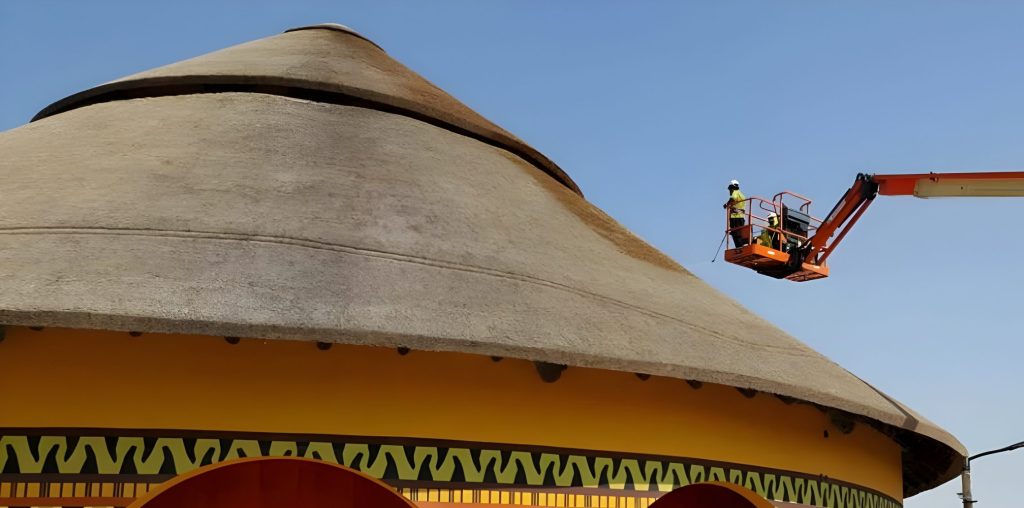
Fireshield is a professionally applied fire-retardant coating that is sprayed onto the finished external thatch surface. It penetrates the reed bundle structure and significantly increases the material’s resistance to ignition and flame spread.
Unlike some fire-retardant treatments that visibly alter the appearance of the surface, Fireshield is formulated to have minimal impact on the natural look of the thatch. The finished roof retains its characteristic honey-gold colour and textured surface — with no film, discolouration, or visible residue.
Fireshield coating does require periodic reapplication as part of routine thatch maintenance, typically every five to seven years depending on the level of weathering and UV exposure. This is a straightforward process that can be carried out by our team during a maintenance visit.

Spain’s Fire Safety Regulations for Outdoor Structures
Spain’s building fire safety framework is governed primarily by the Código Técnico de la Edificación (CTE), specifically Document Basic SI (Seguridad en caso de Incendio). For structures in hospitality, commercial, and multi-residential settings, compliance with CTE DB SI is mandatory and inspected.
For natural roofing materials on outdoor structures, the regulations focus on two key parameters: reaction to fire classification (how readily a material ignites and contributes to fire spread) and external fire spread (how a roof behaves when exposed to fire from an external source such as a neighbouring structure or windborne ember).
Materials used in roofing are assessed under European standard EN 13501-5 for external fire performance and EN 13501-1 for reaction to fire. The Fireshield-treated Cape Reed system achieves classification levels that satisfy the requirements applicable to outdoor hospitality structures, pergolas, gazebos, and residential outbuildings across Spain.
We provide full technical documentation on our fire testing results and material classification for any project requiring formal compliance evidence — whether for planning applications, insurance underwriters, or building control sign-off.
Why This Matters for Your Project
For hospitality and commercial venues
Beach clubs, hotel pool areas, outdoor restaurants, and resort structures fall under the most stringent fire safety requirements. Community of owners (comunidades de propietarios), hotel operators, and commercial licence holders all carry responsibility for ensuring their structures comply with fire codes. Untreated natural roofing materials are increasingly flagged by inspectors and insurers alike.
With Fireshield, we are able to provide the documentation hospitality clients need to demonstrate compliance — and to give their insurers confidence that the structure has been built to an appropriate standard.
For residential properties in fire-risk zones
Southern Spain has experienced increasingly serious wildfire seasons. Properties in areas classified as alto riesgo de incendio — including much of the inland Costa del Sol, the Sierra Bermeja, and coastal pine zones — face additional scrutiny from both local authorities and insurance providers.
For homeowners in these areas, having a Fireshield-treated thatched gazebo, pergola, or outdoor structure significantly reduces both the practical risk and the insurance liability associated with natural roofing materials.
For architects and project specifiers
For architects specifying outdoor structures on luxury residential or commercial projects, the ability to include natural thatch while meeting fire safety requirements opens up design possibilities that would otherwise be unavailable. Fireshield gives you the aesthetic freedom of natural materials with the compliance assurance your projects require.
We are experienced in working alongside architectural teams throughout the specification and approval process, and we are happy to provide product data sheets, test reports, and technical support at any stage of a project.

A Note on Maintenance and Ongoing Compliance
Fire safety is not a one-time installation decision — it requires ongoing attention. For Cape Reed thatched roofs, this means:
Periodic reapplication of the Fireshield surface coating, typically every five to seven years. Visual inspection of the thatch surface and underlying structure at least every two years. Attention to nearby vegetation and combustible materials that could serve as ignition sources during dry seasons. Clear access routes for emergency services where required by regulation.
Cape Reed International offers maintenance programmes for all structures we install, including scheduled Fireshield reapplication, thatch inspection, and structural assessment. Keeping records of these maintenance visits is also useful for insurance purposes, demonstrating that the structure has been actively maintained to the required standard.
Common Misconceptions About Thatch and Fire
“Thatch is too dangerous to use on any commercial property.” This is no longer accurate. With the Fireshield system in place, Cape Reed thatched structures are installed on some of Europe’s most prominent hotel and resort properties — including hospitality venues in Belgium, the UAE, Saudi Arabia, and across Spain. Compliance is achievable; it simply requires the right materials and the right approach.
“Fire-retardant treatments ruin the natural look of thatch.” Fireshield coating is specifically formulated to preserve the appearance of the finished thatch surface. You will not see it, and you will not notice any change in texture or colour. The natural beauty of the material is completely intact.
“Once treated, thatch stays protected forever.” Surface coatings do require reapplication over time. However, the embedded FireBloc layer remains permanently in place throughout the life of the roof. Maintenance reapplication of the Fireshield coating is straightforward and cost-effective when incorporated into a regular maintenance schedule.

Conclusion
The question of fire safety is one that every serious thatch project in Spain must address — and with Cape Reed’s Fireshield system, it is a question that has a clear, well-documented answer. Between the embedded FireBloc barrier, the Fireshield surface coating, and Cape Reed’s 20+ years of experience installing compliant thatched structures across Europe and the Middle East, there is no reason for fire concerns to stand in the way of a beautifully crafted natural roof.
If you are specifying a project or considering thatched roofing and have questions about fire safety, compliance documentation, or insurance, we would be happy to discuss your specific situation.
Frequently Asked Questions
What fire classification does Cape Reed Fireshield achieve?
The Fireshield-treated Cape Reed system achieves fire performance classifications assessed under EN 13501-1 (reaction to fire) and EN 13501-5 (external fire spread). We provide full technical documentation and test reports on request for projects requiring formal compliance evidence.
Does every Cape Reed installation include Fireshield?
Yes. FireBloc fire-retardant underlay cloth is incorporated as standard in every Cape Reed installation. Fireshield surface coating is applied to the completed thatch as part of our standard process. Both components are included unless a client specifically requests an alternative approach, which is rare.